




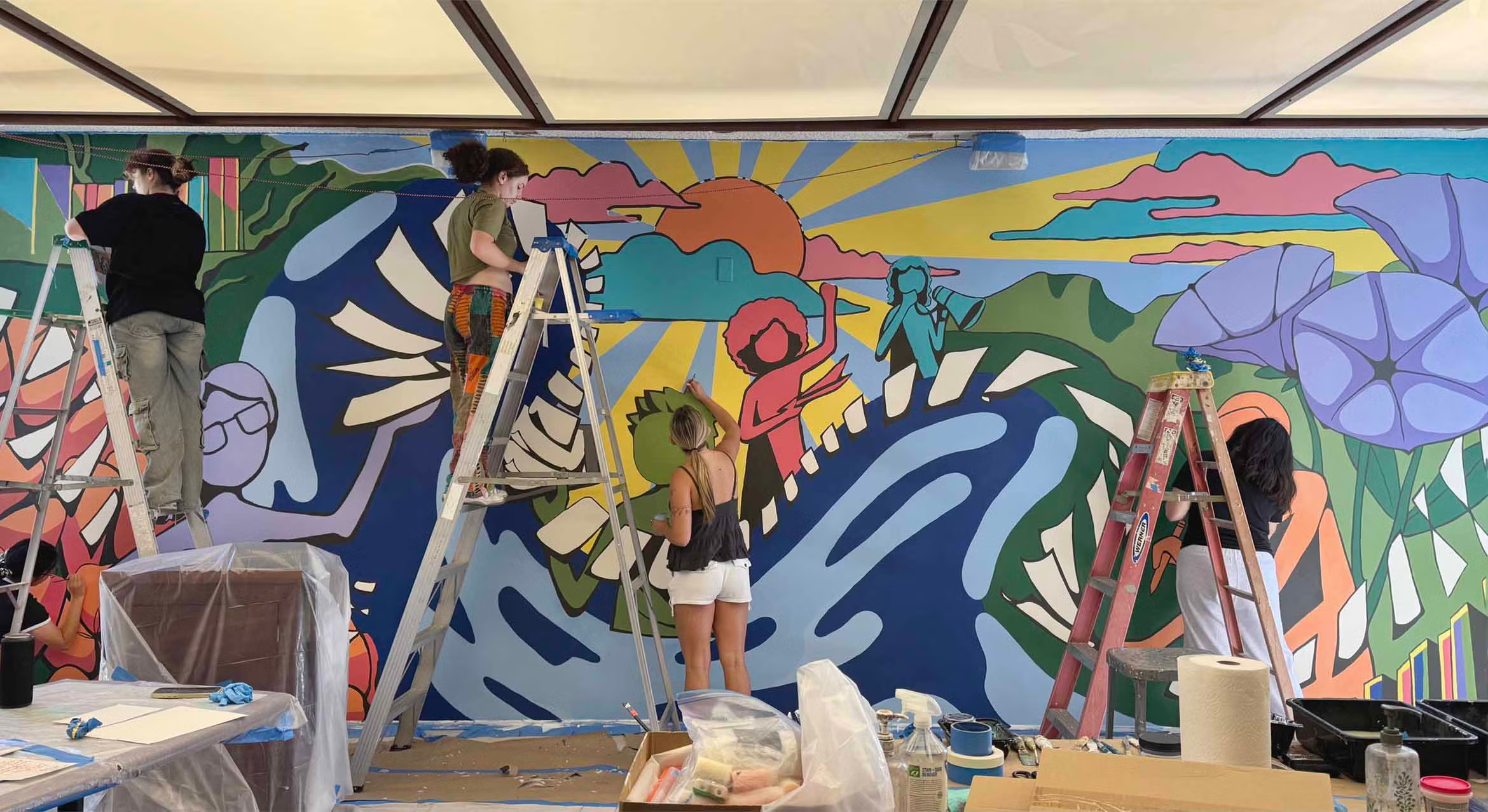
The new mural showcases Santa Barbara’s native plants, its mountains and ocean. Figures pass papers through a wave of movement meant to convey the collaborative nature of research, the circulation of ideas and shared pursuit of knowledge and justice. At the center, there’s a raised fist of empowerment, engagement and collective action.
“My initial thoughts in designing the mural were to portray themes of justice and civil service,” said Sarah Caulder, a third-year student, double-majoring in art and math. “As a class, we worked together to redesign elements of the composition and decide what other topics to include. We focused on themes of civil participation, research and freedom of speech.”
“As for the style of the mural,” she added, “we wanted to make it colorful and engaging. I initially gave it a graphic, cartoony quality, and the class supported that choice.”
Before the first new brushstroke, they gathered to bid respectful farewell to the room’s original piece. Then the hands-on work began.
Mural painting requires both technical skill and conceptual depth, Glover said, noting that her students rose to the challenge. “The color work alone was remarkable. Not a single color came straight from a tube. Every color was analyzed, mixed, tested and documented. Many of the mixtures incorporated five or more colors and were adjusted carefully to work at architectural scale. Each area was then built up through multiple layers to achieve opacity and richness.”
Students made a record of the paint formulas so that colors could be reproduced if and when touch-up work is needed. The professional-grade acrylics specifically formulated for long-lasting murals contributed significantly to the vibrancy and durability of the finished work. Along the way, they protected the room’s walls, windows, floor and furniture, rotated responsibilities and held regular feedback meetings to monitor quality and progress.
“What struck me most, beyond the academic and professional rigor, was watching these eleven students build a genuine community,” Glover added. “They supported one another, solved problems together, shared music and stories while they worked and created a space that was safe, inclusive, professional and genuinely joyful. I’m proud of them. Public art is often described as a gift to a community. What I witnessed this summer was a community forming through the act of making art. This was one of the most meaningful teaching experiences of my career.”
The interdepartmental collaboration was inspired by a similar project, in 2016, when Dan Van Dorn, who worked in the Department of Anthropology at the time, brought in undergraduate art students to produce paintings for half a dozen wall-mounted display cases in the Humanities and Social Sciences Building.
“Yumiko’s expertise, her vision, and her keen students took it a giant step further,” said Van Dorn, now an academic advisor in political science. “My hope is that other departments pick up on the idea — because students truly want to contribute.”