











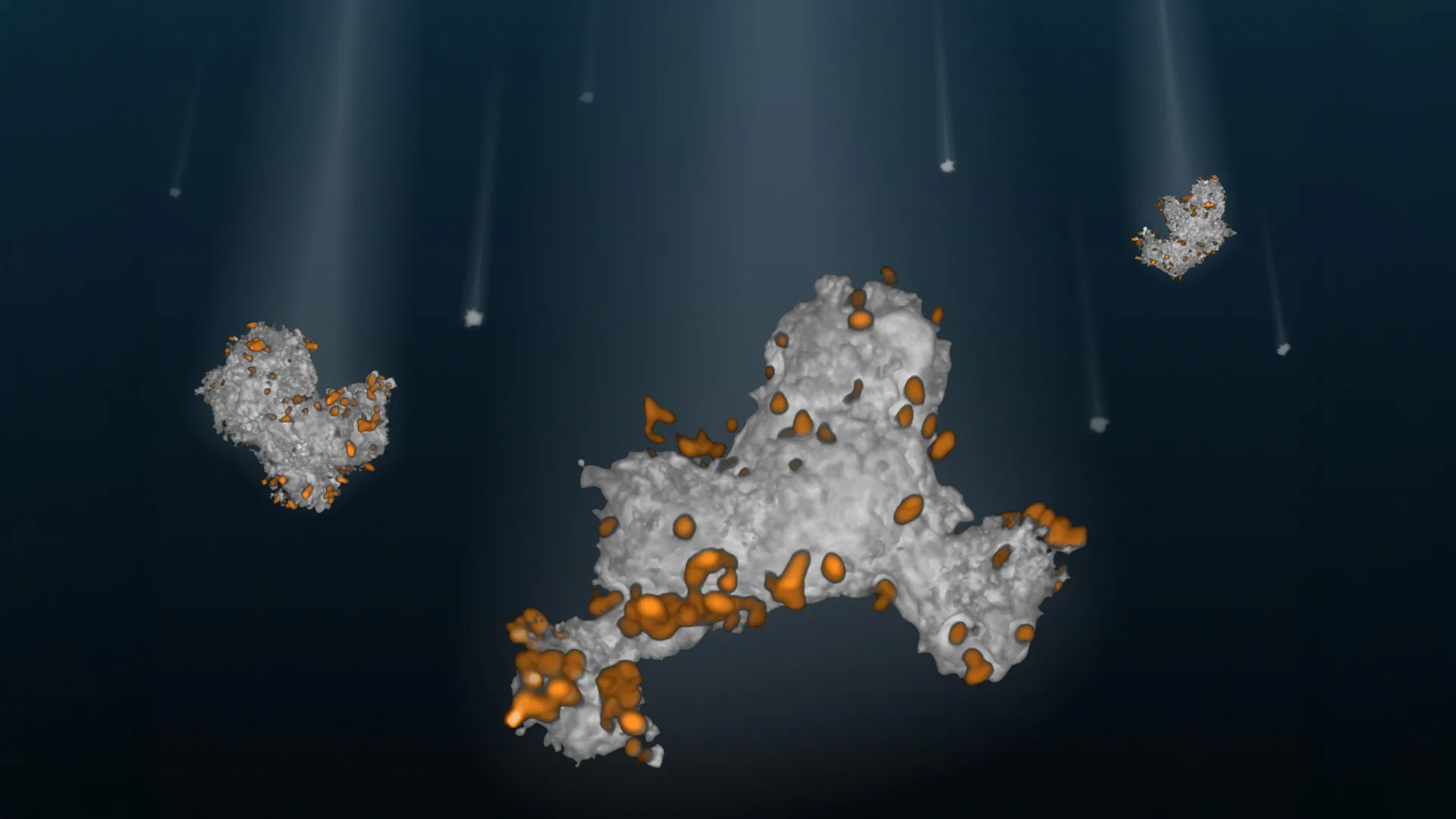
Far below the ocean’s surface, a constant snowfall drifts through the darkness. But unlike the frozen flakes that fall from the sky, this underwater snow consists of tiny clumps of waste, dead organisms, and other debris. Known as marine snow, these particles contain everything from mucus and animal feces to silt and the remains of microscopic plankton.
As this material sinks, it carries enormous quantities of carbon from the upper ocean toward the seafloor. Researchers estimate that marine snow removes more than 10 gigatons of carbon from surface waters each year. Yet only about two gigatons reach depths where that carbon can remain stored for hundreds or even thousands of years.
Why so much carbon fails to make it into the deep ocean has long puzzled scientists. Now, researchers from UC San Diego’s Scripps Institution of Oceanography and the University of Lincoln have identified a surprisingly important factor: how sticky the marine snow is.
Their findings, published October 8 in the journal Science, show that the viscosity, or thickness and gooeyness, of marine snow influences how quickly bacteria break it apart and how far it can sink. According to the researchers, the stickiest particles can transport more than six times as much carbon to the deep ocean as particles with a thinner, less viscous consistency.
How Ocean Slime Helps Store Carbon
Marine snow plays an important role in Earth’s carbon cycle, the natural movement of carbon among the atmosphere, oceans, land, and living organisms. By transporting carbon into deep water, sinking particles can keep some of it isolated from the atmosphere for centuries or longer.
However, not every particle survives the journey. Bacteria feed on marine snow as it descends, gradually breaking down the material and affecting how much carbon reaches the ocean’s depths.
The new research provides the first detailed look at how living bacteria interact with the physical structure of marine snow and, more broadly, mucus itself. These interactions are important well beyond the ocean’s carbon cycle. Similar relationships between bacteria and mucus help sustain coral reefs, kelp forests, plant root systems, and the digestive systems of humans and other animals.
Until recently, scientists lacked the technology to observe these interactions at the microscopic scale needed to understand them.
A Four-Year Quest to See Inside Marine Snow
The project began in 2021, when Bryce Inman, then a postdoctoral researcher at Scripps Oceanography, set out to explore what he calls “the muscoscape.”
“Observing individual bacteria interacting with the physical structure of mucus had never been possible,” said Inman.
Together with colleagues including Farooq Azam, a microbiologist and professor emeritus at Scripps, Inman spent four years trying to overcome that limitation. Multiple attempts were unsuccessful before the team finally developed a working technique in 2025.
Their solution combined 3D confocal microscopy with specially designed fluorescent molecules. Confocal microscopy uses light to capture detailed images at different depths within a sample, allowing researchers to reconstruct its structure in three dimensions. The fluorescent molecules helped make features of the material visible.
For the first time, the scientists could examine the “physical terrain” of individual marine snow particles while watching how living bacteria moved through and interacted with them.
The images revealed a surprisingly intricate microscopic environment, complete with structural differences that affect where bacteria can settle and how easily they can reach the material inside.
Why Stickier Marine Snow Sinks Deeper
Much like snowflakes in the atmosphere, marine snow particles vary considerably. Each contains its own mixture of organic and inorganic materials, creating differences in composition, structure, and viscosity.
The researchers’ new imaging approach, described in a companion study published in Nature Communications, revealed that bacteria preferentially colonize areas near a particle’s surface where the material is less viscous.
The denser, stickier regions deeper inside are much harder for bacteria to penetrate.
“Bacteria can latch on to less viscous portions of each particle, but cannot reach more viscous regions until they break it down,” said Inman. “Think of it like a worm in an apple: the flesh is easy to penetrate, but the core is tough to chew through”
This difference has important consequences for how long marine snow remains intact.
In laboratory experiments, the scientists observed that particles with greater viscosity resisted bacterial degradation and fragmentation for longer periods. Computer simulations further suggested that these stickier particles can descend to greater depths before breaking apart.
Based on these results, the team estimates that highly viscous marine snow can deliver more than six times as much carbon to the deep ocean as less viscous particles.
The findings help explain why some sinking material transports carbon much farther into the ocean than other particles, even though both begin their journeys near the surface.
“How far marine snow can sink is a surprisingly complicated problem, and we have added another – very gooey – piece to the puzzle,” said Inman.
A Discovery With Implications Beyond the Ocean
Although the research focuses on marine snow, its implications extend to many environments where bacteria interact with mucus.
Mucus is often regarded as a relatively simple, slippery substance. But the new imaging technology reveals that it has a complex internal landscape, with microscopic structures that can influence how bacteria behave.
Understanding these physical features could help scientists investigate biological processes in settings ranging from human digestive health to the recovery of damaged coral reefs.
The method also opens opportunities to explore interactions that previously could not be observed directly, providing researchers with a new way to study the microscopic environments inhabited by bacteria.
Mucus, slime, whatever you want to call it, “has a surprising amount of structure,” Inman said. “There are bulges, crevasses, all this sort of structure to it that we really had no idea about at a scale smaller than bacteria. This is the first time we’re really examining this physical habitat.”
The discovery adds an important missing piece to scientists’ understanding of how carbon travels through the ocean. It also demonstrates that something as seemingly ordinary as the thickness of underwater slime can have far-reaching consequences for the planet’s natural systems.
Additional funding for the research was provided by the Simons Foundation and the Engineering and Physical Sciences Research Council.