











Human history is brief when measured against the age of the Earth.
At UC Santa Barbara’s Art, Design & Architecture Museum, Tiffany Chung’s mid-career survey exhibition considers human history alongside the planet’s much longer timeline. “Tiffany Chung: indelible traces” brings together more than 70 artworks spanning 25 years by the Vietnamese American artist and UCSB alumna.
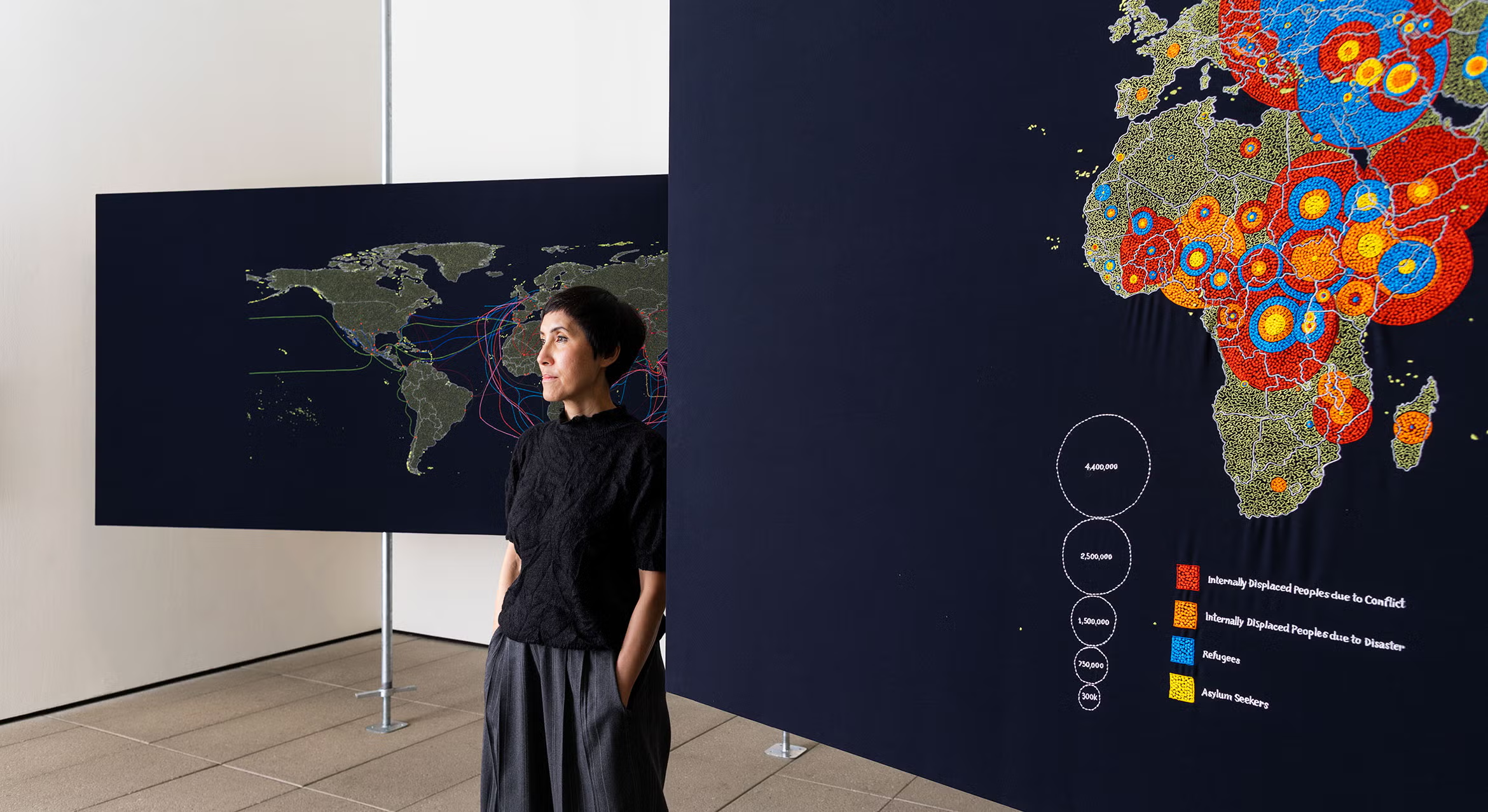
Known for her detailed hand-drawn and embroidered maps, Chung depicts history as layered and interconnected. She combines statistical data, archival research and lived experience to build fuller accounts of historical events — and to represent what has been left out or remains unclear.
Organized by the AD&A Museum and guest curated by Orianna Cacchione, deputy director at the University of Richmond Museums, the exhibition reflects a practice grounded in research.
That research takes visual form through various mediums, in which mapping plays a key role.
“I’ve been acutely aware of the power of cartography,” Chung said, referring to its long history as a tool of colonial authority and state control. At the same time, she sees mapping as a way to “counter official historical accounts, reclaim what has been erased, and shift established narratives, as an act of refusal.” Through layered compositions, she synthesizes vast amounts of material into what she describes as “palimpsests of condensed imagery and information that otherwise can be incomprehensible.”